
Part three in a series about how Boom builds safety-critical hardware quickly and efficiently. See Part 1 (Software) and Part 2 (Vertical Integration).
It was Saturday, March 16th, 2024. The XB-1 team and I were deep in the Mojave Desert, in the final stages of preparing our supersonic demonstrator for its first flight.
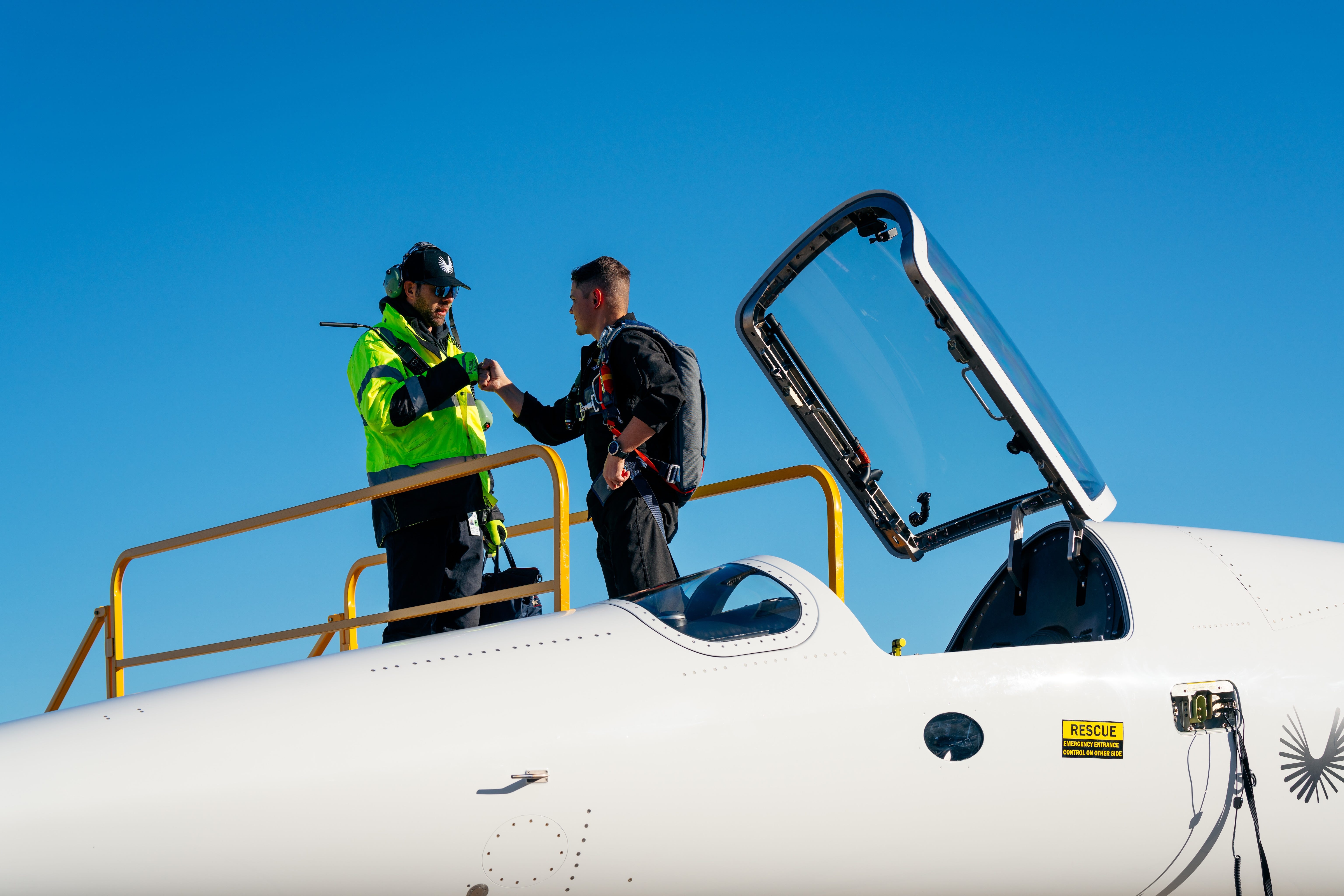
First flight is a crucible moment for any airplane. Years of design and analysis all converge in one instant—when the wheels leave the ground, and reality tests every decision we’ve made. For XB-1, it was even more intense: this was the first airplane built by a brand-new company. That first takeoff would instantly tell us if we’d overlooked something critical.
The pressure was enormous. Investors, the media, fans… everyone wanted to see us fly. Some of the financial pressure I couldn’t safely share with the broader team, but everyone could feel it.
That morning at our daily stand-up, I reminded everyone that while we were close to the finish line, safety came first.
“If you find a problem with the airplane,” I said, “I need to know about it. I might say a four-letter word—but then I’ll say thank you. And I’ll ask: what do you need to fix it?”
That day XB-1 completed its final high-speed taxi test. The weather for the next morning looked perfect. The entire team could sense what was coming.
Then, that afternoon, one of our young engineers—Grace—walked into my office. “Blake,” she said, “we’ve got a problem. The drag chute isn’t working consistently. I think we need to fix it before we fly.”
I might indeed have muttered a four letter word—but I also thanked her. Over the next several days, the whole team rallied behind Grace. We tore down the drag-chute system, found the root cause, fixed it, and reassembled. XB-1 flew safely eight days later, on March 22nd, 2024.
The drag chute wasn’t strictly necessary—it’s an emergency brake. It turned out we never actually needed it anywhere in the flight test campaign. But it was there for a reason—the chance that we might need it. That Saturday, had I shrugged and said, “fly anyway,” it would have been catastrophic in a different way. We’d have set the precedent that when pressure mounts, the safety bar can move. And that destroys a safety culture faster than any mishap ever could.
Grace did the hardest thing you can do in an aviation startup: she brought bad news at the worst possible time. And with her courage, she made us all safer and stronger.
We celebrated her in front of the company. Because at its core, safety culture is defined by how leaders respond when someone brings bad news. Most people instinctively avoid disappointing leadership. So when someone has the courage to raise a red flag, the only right answer is gratitude—and immediate action.
Safety Culture: Easy to Break, Hard to Build
I’m immensely proud of the safety culture we’ve built at Boom.
A generation ago, Boeing led the world in aviation safety. Today, although air travel remains the safest mode of transport by far, we’ve seen tragic and entirely preventable lapses that remind us safety culture is broken more easily than built.
I’ve come to believe that safety culture comes down to two key elements: one behavioral, one philosophical.
How leadership responds when employees surface problems.
Every employee must know they’ll be thanked—not punished—for raising an issue.How we accept risk.
“Safety” doesn’t mean the absence of risk or attempting to eliminate all conceivable risks. It means being open and deliberate about the risk we accept.
Should Safety Be the Top Priority?
Early on, I wrestled with this question. Declaring that safety is the top priority sounds good—but if interpreted literally, I worried it would be paralyzing. If the safest option is always “don’t fly,” we’d never build anything new.
Innovation, especially in aerospace, requires taking risks. But the goal isn’t to eliminate all risk—it’s to decide what kind and level of risk is acceptable—and then take only those risks.
That led me to a more nuanced view: Safety is best understood as taking contextually-appropriate risk. Putting safety first means taking risk seriously—identifying risks consciously, quantifying them whenever possible, and implementing whatever mitigations are necessary to meet a defined safety bar.
Consider this: In the U.S., auto accidents kill the equivalent of two fully loaded 737s every 48 hours. Yet we accept driving as “safe” because it’s necessary, and for now there’s no lower-risk alternative for daily life. By contrast, the original 737 MAX, despite being statistically much safer than driving, was appropriately judged unsafe—because its design flaws were avoidable, and safer alternatives existed.
Safety isn’t an out-of-context absolute: It involves benefit relative to risk, judged in the context of practical alternatives. Something is “safe” when its benefits justify its risks, and no less-risky alternative is practically available. This framing changes everything—and actually increases safety.
Defining a Risk Posture
At Boom, we formalize this idea. Safety means defining a risk posture—then consciously and transparently taking only those risks consistent with it. We define a risk posture for every major effort—and then consciously assess and prioritize risks relative to our standard.
For example:
XB-1: Our experimental jet, flown by a world-class test pilot, was designed with a maximum acceptable catastrophic-failure risk of 1 in 100,000 flight hours (10⁻⁵). That’s appropriate for an R&D program exploring new technology.
Overture: Our commercial airliner, which will carry passengers, targets a risk of no worse than 1 in 1,000,000,000 (10⁻⁹)—the same as any other airliner. While speed is immensely important, we don’t think a doubling speed justifies increased passenger risk—and so we aim to meet or exceed the safety bar achieved by every other airliner.
This is the key: Safety doesn’t mean no risk—it means no unexamined risk. It’s about being intentional and data-driven in what we accept, and transparent about why.
The Pillars of Safety at Boom
After years of iteration, we’ve built several core practices into our DNA:
Safety means conscious risk-acceptance, judged relative to a contextually-appropriate risk posture.
We talk openly about risk and ensure it’s consistent with our posture. “Safety first” means “be intentional,” not “never take risk.” Our test pilots take a very different level of risk than our passengers will.Radical transparency.
We encourage everyone to surface safety concerns. We also maintain an anonymous reporting system as a backup—used rarely now, because trust runs deep.Continuous learning and open sharing.
We discuss safety at every all-hands, share lessons learned, and treat near-misses as seriously as incidents.Celebrating the right behaviors.
We publicly recognize employees who raise issues, like Grace—because surfacing problems is a sign of strength, not weakness.Go/no-go decisions are made independently by the team involved.
I was never in the room for an XB-1 go/no-go decision. We trust the team to make the right decision without senior leadership putting their thumb on the scale.
I like your definition of safety first being the ability to control risk and to anticipate that specific risk. It makes so much more sense than “don’t fly.” It reminds me of the difference between perfectionism and excellence: one is attainable, the other is impossible to work with.
"Yet we accept driving as “safe” because it’s necessary". False statement. First of all "we accept it", because majority accepts it, and since we are living in the system of rape-democracy (it just take to vote over anything, as long as the majority wants something). And majority accepts it not because it is "necessary", but because they assume they will not be killed, so comfort prevails. I didn't ask but I would be VERY surprised if the parent who killed his/her own child with a SUV calmed down arguing the car traffic is "necessary", so, well, tough luck.