
Every September, the same question resurfaces: is it worth upgrading to the latest iPhone? Each year’s model offers a slightly better camera, a slightly better battery—but rarely anything game-changing. Eighteen years after the original iPhone launched, it’s easy to forget how different things once were. The first iPhone didn’t even have 3G or copy-and-paste. The iPhone 3G was a breakthrough. The 3GS was radically faster. The iPhone 4 introduced a front-facing camera. Each release felt like a revolution.
Back then, Apple’s services revenue was tiny—about 6% of the company’s total in 2007. iCloud was still called MobileMe, and AppleCare+ was an afterthought. Today, services represent around 22% of Apple’s revenue—about $85 billion annually, almost four times Apple’s entire 2007 revenue. As the iPhone matured and annual upgrades became less compelling, Apple pivoted: services, support, and aftermarket monetization increasingly took center stage.
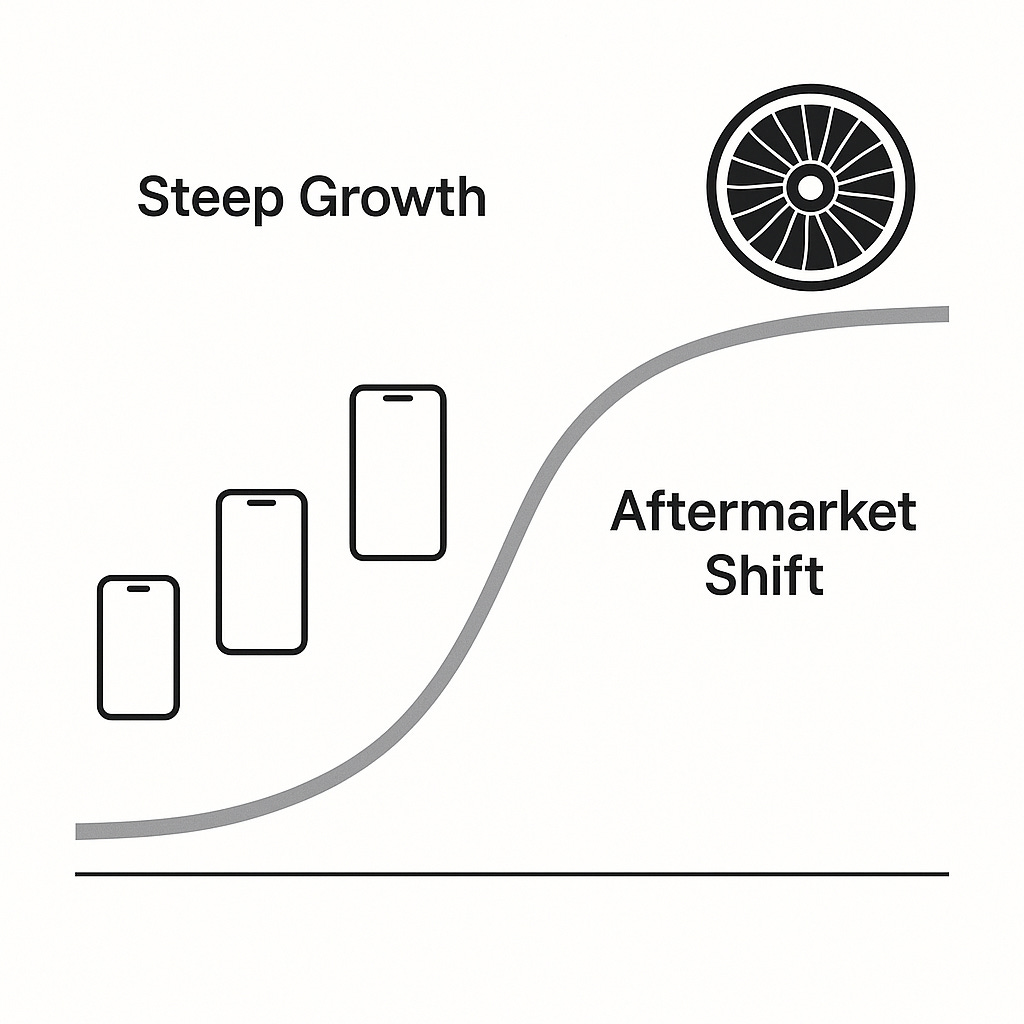
This shift follows a predictable pattern. Technologies move along an S-curve: rapid early improvements, followed by a plateau. As breakthroughs get harder, upgrade cycles lengthen. Through the 1950s, the average commercial airliner stayed in service for just six years—not because they were worn out, but because each new generation offered massive leaps in performance and efficiency. Early airplanes, like early iPhones, had steep S-curves and short replacement cycles.
Here’s the overlooked insight: business models evolve in sync with these S-curves. And this evolution creates both vulnerabilities and opportunities.
As upgrade cycles slow, companies turn to the installed base for growth. Apple leans on AppleCare+, iCloud storage, and Apple TV. Jet engine makers earn more from spare parts and maintenance contracts than from selling new engines—which now are expected to stay in service for decades. For jets, the aftermarket has become more lucrative than making and selling the product itself. Apple still makes plenty from selling new iPhones, but in the jet engine business, things are far worse: engines are often sold at little or even negative margin, with nearly all profits coming from the aftermarket. Indeed, makers see themselves discounting engines in order to buy a piece of the aftermarket.
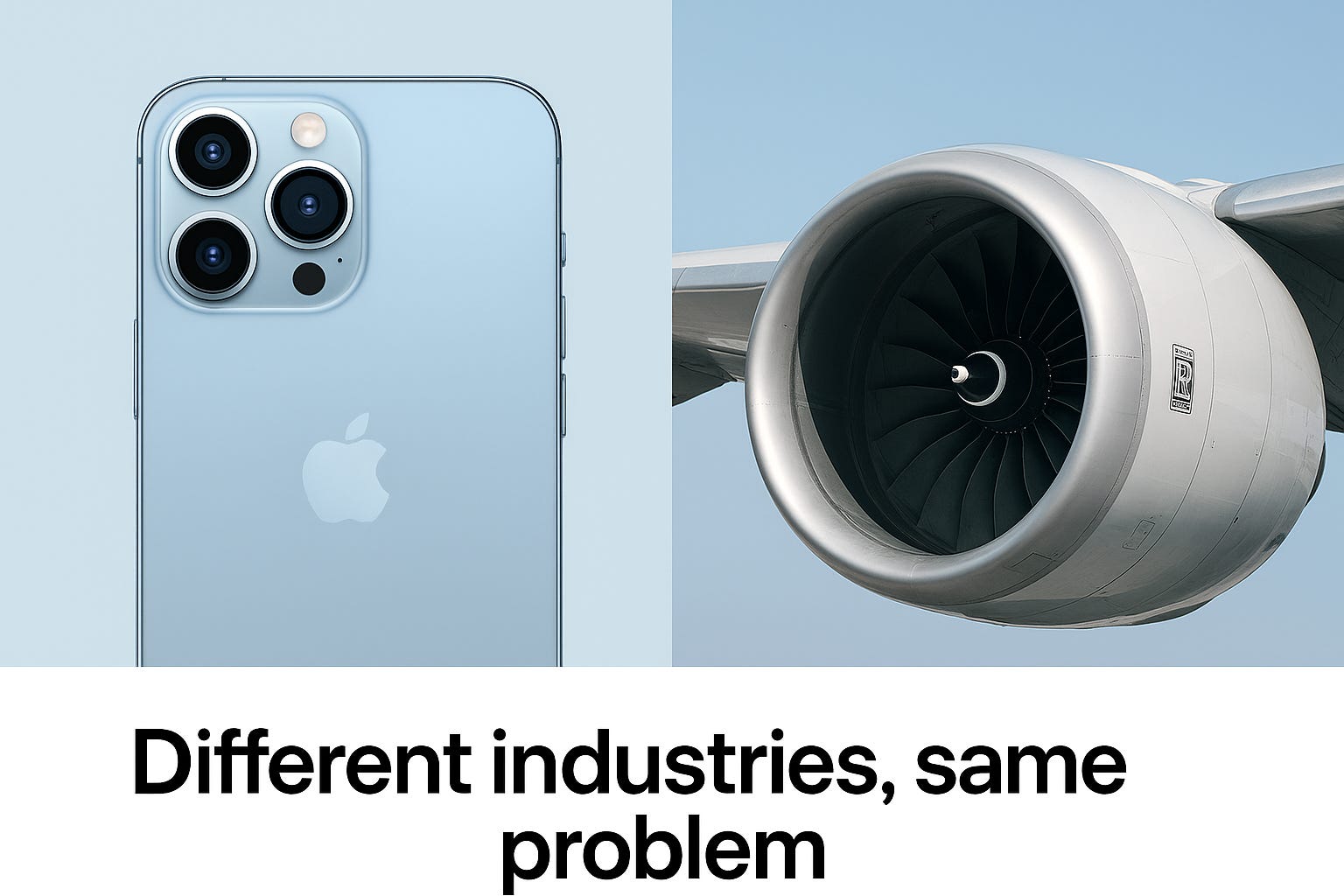
I believe this aftermarket model is a trap. It locks incumbents into protecting spare-parts revenue at the cost of true innovation. A jet engine OEM doesn’t want to build a dramatically longer-lasting engine—it would cannibalize its spare parts business. Moreover, the over-pricing of spare parts creates an incentive for third parties to create knock-off parts. In the case of jet engines, this manifests as allegedly proprietary alloys protected by trade secret… where sometimes the real trade secret is that nothing of substance is meaningfully proprietary.
All of this is fine and well so long as the world stays on the flat part of the S-curve. Customers gradually begin to resent the manufacturers who are milking them on services while investing little in reliability… but so long as nothing meaningfully better comes along, vendor lock carries the day.
But: this is where the seeds of future disruption are sown. I believe supersonic is just such a disruption. We are new just a few years away from a new generation of supersonic jets entering the market—and putting the world at the start of a new, steep S-curve in aircraft and propulsion technology. Boom has pledged to run our aftermarket just above break even, earning our profits through fundamental product innovation.
The broader principle is simple: when technologies plateau, profit pools migrate to the aftermarket. That dependency creates a disincentive for incumbents to improve the core product. New entrants, free from that aftermarket addiction, can attack with fresh technologies and reset the S-curve. Aftermarket-heavy industries are ripe for disruption.
Jeff Bezos once said, “Your margin is my opportunity.” The disruptor’s playbook refines this: your aftermarket profits are my product roadmap.
Nice piece, Blake. I'd also wager that growing dependence on aftermarket revenue also shifts the balance of power within companies, away from the engineers and innovators and towards the accountants, MBAs, marketers, etc. As you point out, it's a recipe for stagnation, but it opens the door for true innovation.
The challenge we find today, in the West at least, is that it's hard to innovate in the "world of atoms". In part, this is because the "low-hanging fruit" of innovation has already been picked, but I would also argue that the regulatory environment has become too burdensome, and, as I wrote in an upcoming essay, our social energy return on investment is diminishing.
Aftermarket seems like "razorblade handles v razorblades", or even "printers v toner". Lots of investment diverted into lock-in strategies vs better value, prices, and competitive innovation.